Tony’s Place
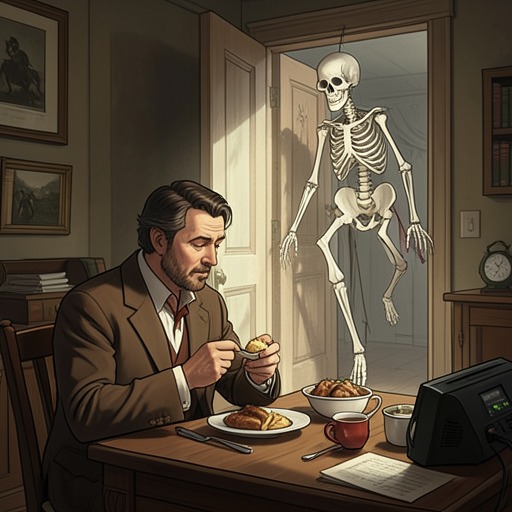
The Pale HorseTony’s Place is a small, unpretentious café whose importance lies in an urgent act of record-keeping: after hearing a dying woman’s extraordinary story, Father Gorman stops there, writes down names he fears he will forget, and hides the list in his shoe. The café is not presented as a criminal establishment. It is shabby and little frequented, and its poor coffee is almost untouched; yet this ordinary stop becomes a key trace in the inquiry into the priest’s murder.
Setting and Character
The café is described as small and down-at-heel, respectable enough, and without anything criminal about it. Its refreshments are of poor quality, and it has few customers. The plainness matters: nothing in the place initially marks it as sinister or exceptional. It is a practical stop on Father Gorman’s way back after visiting Mrs Davis, rather than a destination that advertises danger.
The first account places the visit in gathering twilight, with fog rapidly thickening outside. Father Gorman pauses to consider the story he has heard and how much of it might have come from delirium and high fever. He nevertheless decides that certain names must be recorded while they remain fresh in his memory. The contrast between his uncertainty about the story and his certainty about the need to preserve names gives the café scene its immediate purpose: doubt does not cancel the need to act.
Father Gorman’s Visit
Father Gorman orders coffee and reaches into his cassock for his notebook. Its pocket lining has not been mended, and the notebook, along with a pencil and the few coins he carries, has slipped through the hole. He can prise out a coin or two and the pencil, but cannot retrieve the notebook. Instead, he asks for paper. What he is given is a torn paper bag, and he uses it to write the names down.
The list is not a considered document prepared at leisure. It is a hurried memorandum made with whatever paper is available, because the notebook cannot be reached and the names are easy for him to forget. After folding the scrap, Father Gorman remembers the hole in his pocket and presses it into his shoe, a place he has used before for such a purpose. That small practical gesture preserves the paper while also making its later discovery dependent on someone knowing where to look.
In the investigative reconstruction, the proprietor, Tony, recalls that Father Gorman wrote while his coffee was being brought to him. The priest soon left, having scarcely touched the drink, after completing the list and putting it in his shoe. The barely consumed coffee marks how completely the task displaced the ordinary reason for stopping: the café serves as a brief writing station, not a place where he settles in.
Customers and the Inquiry
Three young men enter while Father Gorman is at the café. The scene first describes them as dressed in Edwardian clothes; the later account characterizes the three boys as being of the Teddy-boy type. Both tellings place them at a table, noisily in the first account, but neither identifies them as participants in the murder. Their presence establishes that the café is not empty, while leaving the crucial details of who else was there uncertain.
The later account also mentions an elderly man who sat at another table and left without ordering. Tony did not notice when he departed or what he looked like. His description was consequently imprecise: an inconspicuous, respectable-looking man of medium height, neither very dark nor very fair, wearing a dark blue or perhaps brown overcoat. The man had not come forward to say that he had seen Father Gorman there. The possibility that he followed the priest is raised, but the account does not establish that he did so.
Narrative Significance
Tony’s Place becomes important through the difference between what the witnesses can establish and what remains unresolved. Tony can place Father Gorman at the café, describe the paper and the concealed list, and recall the other customers; he cannot supply a reliable portrait of the elderly stranger or say when he left. The café thus yields a concrete link in the priest’s last movements without immediately resolving who may have watched him.
The scene’s modest objects carry the investigative weight: a torn paper bag substitutes for a notebook, a damaged pocket explains why the memorandum is made, and a shoe becomes its temporary hiding place. Set against the worsening fog and Father Gorman’s uncertainty about the story he has heard, the café offers neither supernatural proof nor a dramatic confrontation. It gives the inquiry something more fragile and useful: a written record, produced in haste, and a final public location whose ordinary witnesses can confirm part of the chain but not all of it.